
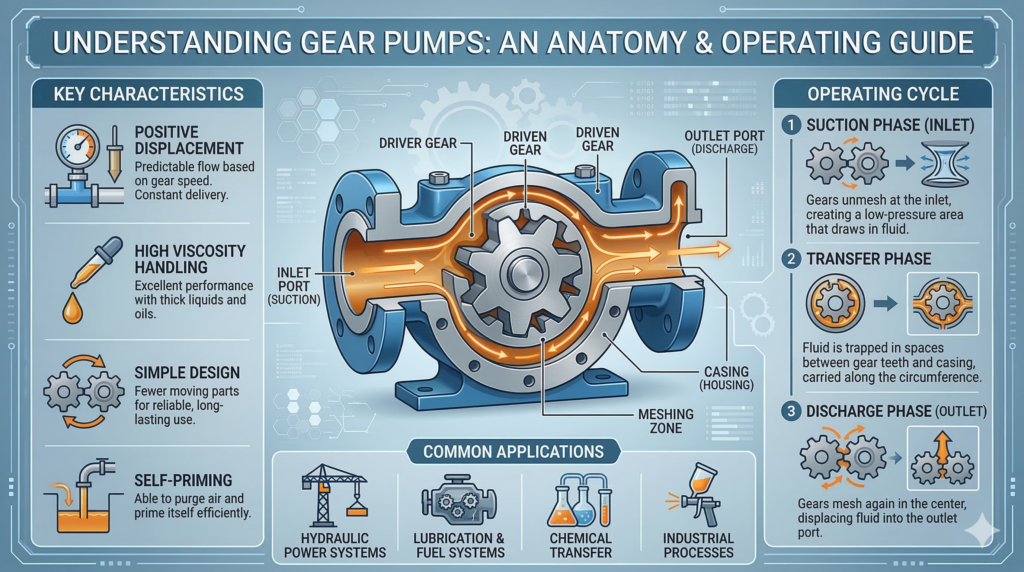
Understanding Gear Pumps: An Overview
In this blog post, we explore the fundamentals of gear pumps, a cornerstone of hydraulic systems. Whether you’re a student just beginning your journey into fluid power, an engineer refining your knowledge, or a curious enthusiast, this guide will help you grasp the essential principles, components, and applications of gear pumps.
What Is a Gear Pump?
A gear pump is a type of positive-displacement pump that moves fluid by trapping it in the cavities between the rotating gears and the pump casing. Unlike centrifugal pumps, which rely on velocity and pressure, gear pumps deliver a steady, consistent flow regardless of pressure changes. This makes them ideal for applications requiring precision and reliability.
Gear pumps are prized for their:
- Simplicity – Few moving parts mean fewer failure points.
- Durability – Built to withstand high pressures and harsh environments.
- Efficiency – Capable of maintaining flow even under varying loads.
Key Components and How They Work
Understanding the internal structure of a gear pump is key to appreciating its function. Here are the main components:
- Drive Gear and Idler Gear: These two interlocking gears are the heart of the pump. The drive gear is powered by a motor, and it turns the idler gear. As they rotate, they create suction at the inlet and push fluid toward the outlet.
- Pump Housing: This encases the gears and maintains tight clearances to prevent internal leakage. The precision of the housing is critical to the pump’s efficiency.
- Inlet and Outlet Ports: Fluid enters through the inlet as the gears unmesh, creating a vacuum. It is then carried around the outer edges of the gears and expelled through the outlet as the gears mesh again.
This simple yet effective mechanism ensures a non-pulsating, continuous flow, which is essential in many industrial and mechanical systems.
Types of Gear Pumps
Gear pumps come in two primary configurations, each suited to different applications:
- External Gear Pumps
- Feature two identical external gears.
- Known for high-pressure capabilities and mechanical efficiency.
- Common in hydraulic systems and industrial machinery.
- Internal Gear Pumps
- Consist of a larger internal gear and a smaller external gear inside it.
- Operate more quietly and are better suited for low-viscosity fluids.
- Often used in food processing, chemical handling, and lubrication systems.
Advantages and Applications
Gear pumps are widely used across industries due to their versatility and reliability. Key advantages include:
- Compact design – Ideal for space-constrained systems.
- High reliability – Minimal wear and tear with proper maintenance.
- Ease of maintenance – Simple construction allows for quick servicing.
- Consistent flow rate – Delivers steady output regardless of system pressure.
Common applications include:
- Hydraulic power units
- Automotive transmissions and lubrication systems
- Chemical and food processing
- Fuel and oil transfer systems
Educational Value
This topic is especially valuable for:
- Engineering students – Learning the foundations of fluid power and mechanical systems.
- Maintenance technicians – Understanding how to troubleshoot and service gear pumps.
- Newcomers to hydraulics – Gaining a solid introduction to one of the most common pump types in industry.
By Alex Hitsman
Sales manager